Tutorial 4 – Predicting Energies and Nonadiabatic Couplings
In Tutorial 3, we showed how to train a NN model for predicting energies, forces and nonadiabatic couplings. Here we demonstrate, how to use the trained model, to predict the energies and nonadiabatic couplings for a geometry of the sample molecule, which was not included in the database.
[1]:
import os, sys
import numpy as np
import matplotlib.pyplot as plt

import ase
from ase.db import connect
Molecule out of Dataset
In the following we create an Atoms object from the symbols and positions of our target molecule.
[2]:
# molecular symbols of target structure (same as database)
symbols = 'CNHHHH'
# positions of atoms in target structure (not included in database)
positions = np.array(
    [[ 0.0000,  0.0000,  0.0000 ],
     [ 2.4321,  0.0000,  0.0000 ],
     [-1.0111,  1.7951,  0.0000 ],
     [ 3.4373,  1.6202, -0.2566 ],
     [ 3.4373, -1.6202,  0.2566 ],
     [-1.0111, -1.7951,  0.0000 ]]
)
# create ase Atoms object
target_mol = ase.Atoms(symbols=symbols, positions=positions)
Define the calculator
In this step, we define a calculator for predicting for the target geometry the properties. Therefore, we have to specify the path to the trained model (see Tutorial 3) as well as the neighbor list for building the representation.
[3]:
from schnetpack.transform import MatScipyNeighborList
from spainn.interface import NacCalculator

# set up calculator for predictions
calc = NacCalculator(
    model_file=os.path.join(os.getcwd(), 'train', 'best_model_E_F_C'),
    neighbor_list=MatScipyNeighborList(cutoff=10.0)
)
# apply calculator to target molecule
target_mol.calc = calc
In the next step, we get the predictions from our model, by calling the get_properties function for the set of properties, we are interested in (here energies and nonadiabatic couplings). Note, the NacCalculator always returns nonadiabatic couplings \(\mathbf{C}_{ij}\) rather than the smoothed nonadiabatic couplings \(\mathbf{C}_{ij}^s\) employed in the training. Nevertheless, the predictions, need to be requested with the same property key as used in the training.
[4]:
# predict energies and nacs from NN model
pred = target_mol.get_properties(['energy', 'smooth_nacs'])
pred
[4]:
{'energy': array([-94.67488565, -94.42807255, -94.33222212]),
 'smooth_nacs': array([[[-5.55834436e-02, -1.67016947e-17, -7.63236560e-19],
         [-1.71284160e-01,  4.90413892e-17, -3.03844639e-19],
         [-9.52767548e-01,  1.31373348e-16,  2.18561979e-17]],

        [[-9.73515189e-02, -4.93364229e-17,  2.94756393e-18],
         [-2.03955834e-01,  1.57202331e-18, -3.02399188e-18],
         [ 7.18859946e-01, -4.18493612e-17,  5.87670367e-18]],

        [[ 3.81299868e-02, -4.82265658e-02, -1.96809142e-04],
         [-1.94629845e-02,  3.90448386e-02,  1.13046205e-03],
         [ 1.16888676e-01, -9.81919929e-02,  4.69116636e-03]],

        [[-3.24237656e-02, -1.53159303e-02,  2.94397172e-03],
         [ 1.06732541e-01,  4.91115399e-02, -8.72029081e-03],
         [ 2.22506380e-02, -3.17968002e-02,  3.09087171e-04]],

        [[-3.24237656e-02,  1.53159303e-02, -2.94397172e-03],
         [ 1.06732541e-01, -4.91115399e-02,  8.72029081e-03],
         [ 2.22506380e-02,  3.17968002e-02, -3.09087171e-04]],

        [[ 3.81299868e-02,  4.82265658e-02,  1.96809142e-04],
         [-1.94629845e-02, -3.90448386e-02, -1.13046205e-03],
         [ 1.16888676e-01,  9.81919929e-02, -4.69116636e-03]]])}
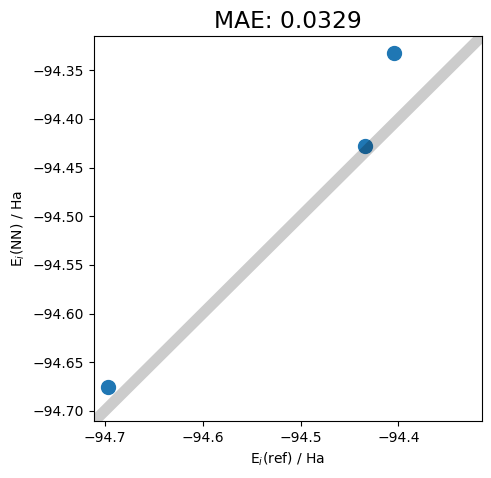
Mean absolute error for energies
[5]:
# reference energies from (6,4)-CASSCF/cc-pVDZ calculations
ref = {'energy': np.array([-94.69603647, -94.43388056, -94.40410243])}

mae = np.mean(
    np.abs(np.asarray(pred['energy']).flatten()
           - np.asarray(ref['energy']).flatten()
          ))

print('MAE: '+str(mae))
MAE: 0.03294638125980498
Visualization of prediction quality for energies
[6]:
# define plot
plt.figure(figsize=(5, 5))
plt.scatter(ref['energy'], pred['energy'], s=100.0)
plt.rcParams["figure.autolayout"] = True
plt.rcParams["font.size"] = 14

# get limits of axis and aplly same for x and y-axis (square plot)
limits = [*plt.xlim(), *plt.ylim()]
lower_lim = min(limits)
upper_lim = max(limits)
plt.xlim(lower_lim, upper_lim)
plt.ylim(lower_lim, upper_lim)

# plot y=x line to guide eye
plt.plot([lower_lim-2.5, upper_lim+2.5], [lower_lim-2.5, upper_lim+2.5], c='k', alpha=0.2, linewidth=8, linestyle='-')

plt.xlabel('E$_i$(ref) / Ha')
plt.ylabel('E$_i$(NN) / Ha')
plt.title('MAE: '+str(round(mae, 4)))

plt.show()